

Tangier, the International Zone of Morocco. Thursday, 12th August, 1954. Late afternoon.
SCENE
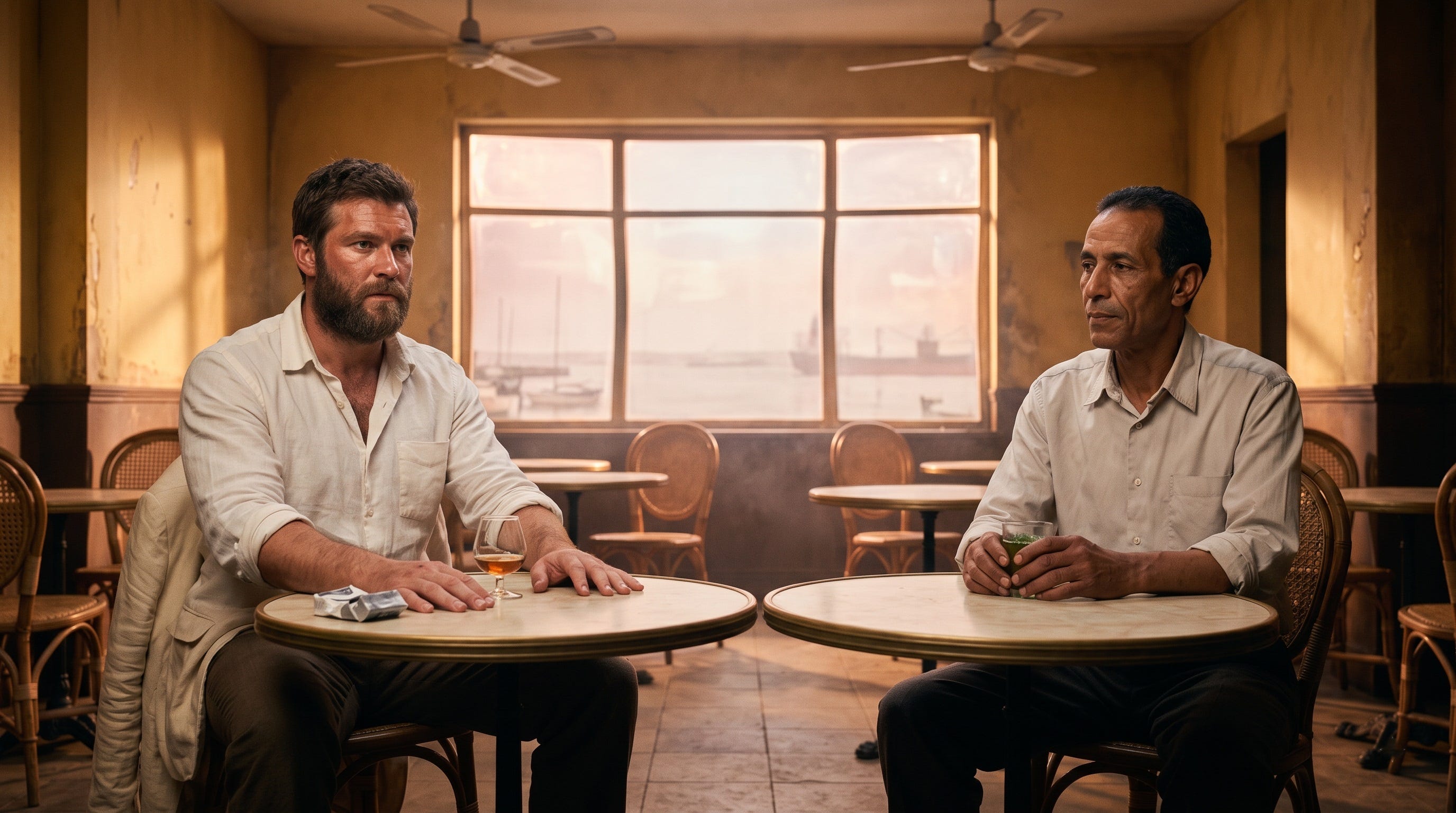
A small café on the Rue de la Marine, Tangier. It is cramped, salt-stained, and has the settled look of a place that has been enduring rather than prospering for a very long time. Four or five tables of unmatched cane chairs; most of them empty at this hour, which falls between the lunch crowd and the evening one, in the long, hot slack of mid-afternoon. Through a window – its glass warped by age so that it bows slightly inward and everything beyond it is visible but subtly wrong – the harbour lies flat and colourless in the haze. Two fishing boats are tied at the quay. A freighter sits on the horizon, not moving, or not moving perceptibly. Two ceiling fans turn above the room with the effortful resignation of men who have been working since morning and have not been thanked; they stir the cigarette smoke of many previous afternoons but do not disperse it. The walls are the colour of old butter. The light, arriving from the west at an amber angle, is late and heavy – the last of a day that has not been especially kind.
At the table nearest the warped window sits THE COLLECTOR. He is somewhere in his late forties or early fifties – his age is difficult to read, smoothed as it is by a life largely lived before sunrise, away from the full sun. He is a slight man, dressed carefully in worn clothes: a clean shirt, the cleanliness of which has cost some effort and paid it gladly. His hands, resting around a glass of mint tea, carry the marks of his trade – strong and rough, with a darkness ingrained in the grooves beneath the nails that no amount of scrubbing will entirely lift, and which he no longer thinks about lifting. He carries also a persistent ache in the small of his back – the permanent charge levied by fifteen years bent over a cart – and he has found, by long acquaintance, the angle of sitting that costs him least, and settled there. He is looking at the harbour through the warped glass with the unhurried attention of a man who has found the view adequate and sees no reason to trouble it with an opinion. He has slept since before noon. He is still tired, but differently – the tiredness of the body rather than the eyes. He stirs his tea slowly. He is content.
THE SOLDIER enters through the door. He is a large man – broad-shouldered, weathered in the grain of him, with a beard that has not been tended in some weeks and that gives him the look of a man who has made a decision not to care about something and has cared very much about that decision. He is in civilian clothes – linen jacket, open collar – but his civilian clothes sit on him with a faint wrongness, the way borrowed things do. He moves through the room as men of his kind move through rooms: scanning left to right before committing to a direction, noting the exits and the occupants with the brisk, unconscious accounting of a man who has spent years in rooms that required it. Two Moroccan men play dominoes near the far wall. A waiter rearranges glasses behind the bar with his back turned. The collector at the window. The soldier’s eyes pass over all of them and return, without his having decided they should, to the collector, and with the annexing ease of a man who has always occupied other men’s ground, he drops into the chair at the adjacent table. He signals the waiter with two fingers – brandy, or whatever the house keeps – and lights a cigarette, and exhales a long, slow breath that is as close as he comes to admitting that something is not right.
THE SOLDIER: (To no one. To the smoke. To the sluggish air.) God’s own furnace.
He removes his jacket. Hangs it on the chair-back. Removes it. Lays it over his knee. Picks up the glass the waiter has set before him. Sets it down without drinking. Looks up at the ceiling fans.
THE SOLDIER: (More loudly, as though the room itself has given him insufficient welcome.) Not a breath of it. Not one damned breath. (He looks at the ceiling fans with undisguised contempt.) All that turning and nothing arrives. Decorative. Like a general’s medals. Every bit as useful.
Silence. The collector does not look up. He stirs his tea.
THE SOLDIER: You understand me? You speak English?
THE COLLECTOR: (Without looking up.) A little. Enough.
THE SOLDIER: Enough. (He tastes the word.) Every man in this city speaks enough of something. Enough French to argue with a taxi driver. Enough Spanish to swear at him. Enough Arabic to misread a souk and go home thinking you’ve won. (He drinks.) I had a corporal once. Fine man. He used to say a man ought to know enough of every language to make a proper fool of himself in it. He called it the mark of civilisation.
THE COLLECTOR: (After a pause.) There are worse marks.
THE SOLDIER: (He looks at the collector for the first time – brief, blunt, assessing.) Hm.
He drums two fingers on the table. Stops. Begins again. Stops. Pushes his glass to the side and pulls it back.
THE SOLDIER: How long have you been in Tangier?
THE COLLECTOR: All my life. I was born here.
THE SOLDIER: Born here and stayed.
THE COLLECTOR: Born here and stayed.
THE SOLDIER: (He says this as though turning over something he cannot quite identify.) That must be – something. To be born somewhere and simply remain. Not to have –
He does not finish. He looks at the harbour through the warped glass.
THE COLLECTOR: It is only strange from the outside.
THE SOLDIER: Ha. (Without great warmth, but not unkindly.) Yes. There’s the thing of it.
A pause. The dominoes rattle. A cart passes in the street outside – a man’s voice calling, unhurried, a single word, then silence again.
THE SOLDIER: What do you do here? For work.
THE COLLECTOR: (He looks at the soldier now. Steadily, without apology or performance.) I work in the medina. Before the morning.
THE SOLDIER: Night work?
THE COLLECTOR: Before the morning.
THE SOLDIER: There’s a distinction there.
THE COLLECTOR: (Simply.) Yes.
THE SOLDIER: What sort of work?
THE COLLECTOR: (Without apology, without defiance; in the tone of a man stating a known fact.) I collect what people do not wish to keep. The cesspits of the medina – the waste that gathers, that no one wishes to think about, that someone must carry away. I carry it away. Before the city wakes.
Silence. The soldier looks at him. His expression traverses several rooms in quick succession.
THE SOLDIER: (Very quietly.) Good God.
THE COLLECTOR: (Mild.) I have thought so myself.
THE SOLDIER: How long?
THE COLLECTOR: Fifteen years of my own. Before that, my father’s work. I went with him from when I was a boy.
THE SOLDIER: (Despite himself.) From a boy?
THE COLLECTOR: From a boy. My father had a saying – that a man should know what a city produces before he claims to understand it. He had his reasons for saying so.
THE SOLDIER: (Flatly.) I’ll credit him for that.
A pause. The soldier looks at the collector with an expression he cannot categorise – contempt has been present and has given way to something else, something he does not reach for a name.
THE SOLDIER: And the – the sheer wretchedness of it. In fifteen years. The lowest thing. What people amount to, at the bottom of it all. Does it not make you –
THE COLLECTOR: (He considers this genuinely.) Make me what?
THE SOLDIER: Contemptuous of them.
THE COLLECTOR: (After a pause.) No more than I am contemptuous of myself.
THE SOLDIER: That’s not the same thing.
THE COLLECTOR: (With quiet certainty.) I think it is.
The soldier looks at him. A longer pause.
THE SOLDIER: You’re a philosopher of the cesspits.
THE COLLECTOR: (Mildly, without offence.) I am a man who empties cesspits.
The soldier stands. He goes to the window. He sets one hand on the warped frame and looks through the distorted glass at the harbour – the boats, the flat grey water, the freighter on the horizon that through the warped glass appears, faintly, as though it is sinking. He speaks with his back to the room.
THE SOLDIER: I have smelled things a man ought not to have smelled. In the field. You understand me? War. (He says it as though the word is its own complete sentence, tolerating no additions and requiring none.) Korea. Before that, Italy. Before that – God’s teeth, I was seventeen when they gave me a rifle and told me England needed me. And I thought it would be –
He stops.
He turns from the window, goes back to his chair, but does not sit. He stands behind it, his hands on the chair-back.
THE SOLDIER: You know what reputation is? The kind a soldier earns? It’s smoke. The bubble of it. The great shining bubble of honour and glory and whatever name you want to give the thing they put in the posters and the speeches. You breathe it in and it clears and then you’re still standing in the same field with the same cold and the same dead, and none of it looks the way they told you it would look. Not one damned bit of it.
He sits.
THE SOLDIER: I met a man at Cassino. Old soldier – wire and bone, the kind of man you’d look at and wonder how he’s still upright, and then you’d watch him for half an hour and you’d stop wondering. In the worst of it. Every man around him was – (he waves his hand) – and he went on. Without noise. Without complaint. I asked him afterwards how he managed. He said: look at the next thing. Don’t look at the whole of it. Just this, and then this, and then this.
Pause.
THE SOLDIER: Dead inside the week.
The collector says nothing. He waits, with the patience of a man accustomed to darkness and slow work.
THE SOLDIER: There was a man in my platoon in Korea. I won’t say his name. He’s dead. He had a habit – when things were very bad, when the shelling ran through the night, when the cold was the kind of cold that gets into your thinking as well as your coat – he would say it in the dark. Not loudly. Just: steady on. People are better than you think.
He picks up his glass. Puts it down.
THE SOLDIER: He believed it. That’s what I mean. He didn’t say it as barracks comfort, something to get through the hour with. He believed it. Every time. Every rotten, bloody time.
Pause.
THE SOLDIER: He is dead.
THE COLLECTOR: (Very quietly.) I am sorry.
THE SOLDIER: (With a pride that costs him something.) He died well. If that counts for something.
THE COLLECTOR: It counts.
THE SOLDIER: Does it? (He looks up, sharply.) Does it genuinely? Because I have been trying to find where it counts and I cannot – (the fire goes out of his voice and something else comes in, something rawer, quieter) – I have been in this city eleven days. Before that Lisbon. Before that I don’t know what you’d call it. Drifting from one – and I cannot –
He stops. He looks at the table. When he speaks again, it is more quietly than before.
THE SOLDIER: I cannot sleep. That is the plain truth of it. I lie down and I cannot sleep and I cannot work out whether he was right.
Pause.
THE COLLECTOR: (He sets down his tea. He looks at the soldier with the full attention of a man who is very good at looking. When he speaks, it arrives from the side, the way his answers tend to.) I am not at peace, if that is what you see in me. I am tired. There is a difference.
THE SOLDIER: (After a moment.) What difference?
THE COLLECTOR: A tired man can sleep.
Silence. The soldier stares at him. Looks away. One of the ceiling fans makes a soft, laboured sound, like a sigh. A fly crosses the table and is gone.
THE SOLDIER: (Quietly, after a long pause, still looking at the table.) Does it not – in fifteen years of that work, in every lane and house and foul pit in this city – does it not make you despair of them? Of people?
THE COLLECTOR: (Without hesitation.) No.
THE SOLDIER: Just no.
THE COLLECTOR: No.
THE SOLDIER: (With sudden heat.) How? You go into those places, you see what they produce, you handle it, year upon year, every house in the medina, every rotten corner of this city’s life, and you tell me you do not look at a man in the street and think – I know what you are, I know what you are made of at the end of everything, and it is –
THE COLLECTOR: (Steadily, without raising his voice.) I do know what they are made of. And that is not all I know.
A silence.
THE SOLDIER: (The heat gone out of him. Quietly.) Then what else is there?
The collector looks at him. He makes a decision. He folds his hands around his glass.
THE COLLECTOR: You are asking me something.
THE SOLDIER: I am asking you whether –
THE COLLECTOR: No. (Gently.) Something underneath that. You have been carrying it a while.
Silence. The soldier’s jaw tightens. He reaches for a cigarette, finds the pack empty, crumples it, sets it on the table. His hands are not entirely steady.
THE SOLDIER: (Very quietly, and with immense difficulty – the difficulty of a man who has mistaken silence for strength for so long that speaking feels like surrender.) I want to know –
He stops.
He tries again.
THE SOLDIER: I want to know if a stranger has ever done something – something they owed you nothing toward, that cost them nothing much, or cost them something and they did it anyway – that made you think he was right. That people are – that there is still something in people worth –
He cannot finish. He makes a cutting gesture with his hand and looks away, at the harbour, at the freighter that through the warped glass appears to be slowly, perpetually, going under.
THE SOLDIER: Never mind. The whole damned –
THE COLLECTOR raises one hand. Quietly. With the practised calm of a man who knows how to stop something heavy without straining himself.
Silence.
THE COLLECTOR: Last February. I am certain it was February – there had been a cold wind off the sea for three nights, the kind that finds the lanes the sun never reaches and turns the stones to ice. Before the morning call. I was working in a lane behind the Street of the Dyers. Do you know that part of the city?
THE SOLDIER: (Shaking his head.) No.
THE COLLECTOR: Very old. Very narrow. The houses lean toward each other at the top until the sky between them is only a stripe, as though someone has cut it between the walls with a blade. In the day it is dim. At two in the morning it is nearly blind.
He pauses. He takes his tea, finds it has gone cool. Sets it down.
THE COLLECTOR: There was a house at the end of this lane that had been neglected for some months. The owner had been ill. When these things are left, the work is harder. Much harder. I do not need to describe how much.
THE SOLDIER: (Quietly.) No.
THE COLLECTOR: I had been there perhaps two hours before the call to prayer. Working. (A pause.) There is a way of working in those conditions that becomes only itself. You do not think about what you are handling. You count the buckets. You check the lids. You move the cart one length forward and go back for the next. Just this, and then this, and then this.
He looks at the soldier when he says this. The soldier does not look away.
THE COLLECTOR: At some point I became aware that I was not alone in the lane.
THE SOLDIER: (Instinctive, alert.) Trouble?
THE COLLECTOR: (A slight shake of his head.) A man. Standing at the far end. An old man, I thought – though in that darkness you cannot see much. He was simply standing there. Not moving. I thought perhaps he could not sleep. Old men come out before the morning for air, for the quiet of it. You will have seen this.
THE SOLDIER: (A nod, from somewhere private.) Yes.
THE COLLECTOR: I did not speak to him. I went back to my work. When I had finished – when I was bringing the cart out of the lane toward the wider street – he was still there. He had not moved. And in his hands he was holding a candle. A small candle in a glass holder, the kind a man keeps by his bed. He was holding it up.
The collector is quiet for a moment. He is not telling this for effect. He is remembering it with care, with the deliberateness of a man who checks each detail and sets each thing in its right order.
THE COLLECTOR: He had stood in that lane, in the cold, in the smell, for two hours. While I worked. Holding a candle so that I would have a little more light.
Pause.
THE COLLECTOR: He did not speak. I think he understood that if he spoke I would feel I must speak in return, and at that hour, in that place, with my hands as they were – there is nothing comfortable for either man to say. He had brought me no food, no money, nothing I required. Only the light. Only that he had stayed.
Pause.
THE COLLECTOR: When I brought the cart out to the wider street, I heard his door close. The lane was dark again.
A long silence. One of the ceiling fans stutters once and steadies. The light through the warped window has gone from amber to something closer to rose. The freighter on the horizon has not moved, or not perceptibly.
THE COLLECTOR: He speaks to the middle distance, to the harbour, to the memory itself – and then, as though remembering where he is, he turns and says the last words to the soldier directly. I have thought about this man many times since. I do not know who he was. I do not know what manner of man he was in the rest of his life. I will perhaps never see him again. I do not think he told anyone what he had done – there was nothing in it for him to tell. He did it because it was two in the morning and he could not sleep, and a man was working alone in the dark, and he had a candle and a pair of hands and knew what to do with them.
He lifts his glass. It is empty. He sets it down with the precision of a man who checks that every lid is seated before he moves on.
THE COLLECTOR: (Simply, with no more or less weight than the words require.) Your friend was not wrong.
Silence.
THE SOLDIER does not speak. He is looking at the table. His hands lie flat on it – not tapping, not drumming, not reaching for his glass or the crumpled cigarette pack. Resting. The muscles in his jaw move once and are still. His eyes, in the rose light, are very bright in a way that has nothing to do with good cheer and everything to do with the long effort of a man who has been refusing to feel a thing for eleven days, or longer, and has come at last to the end of that effort.
He does not reach for his glass. He does not stand. He does not fill the silence with an oath or a challenge or any of the familiar artillery with which he arrived. He simply – sits. And the quality of his sitting is wholly unlike the quality of it when he walked through the door. He is still. He sits as a man sits who has been carrying something very heavy for a very long time and has been permitted, for this one moment, to set it down.
Outside, from the direction of the medina, faint and unhurried, the muezzin begins the evening call. The sound rises and falls without urgency, as though the city itself is exhaling something it has held since morning.
The ceiling fans turn. The smoke drifts. The rose light deepens in the warped glass.
Neither man moves. There is nothing, for now, that needs to be done.
END OF SCENE
Bob Lynn | © 2026 Vox Meditantis. All rights reserved.