
The Scribe and the Shadow
What is the fictional character you relate to the most?

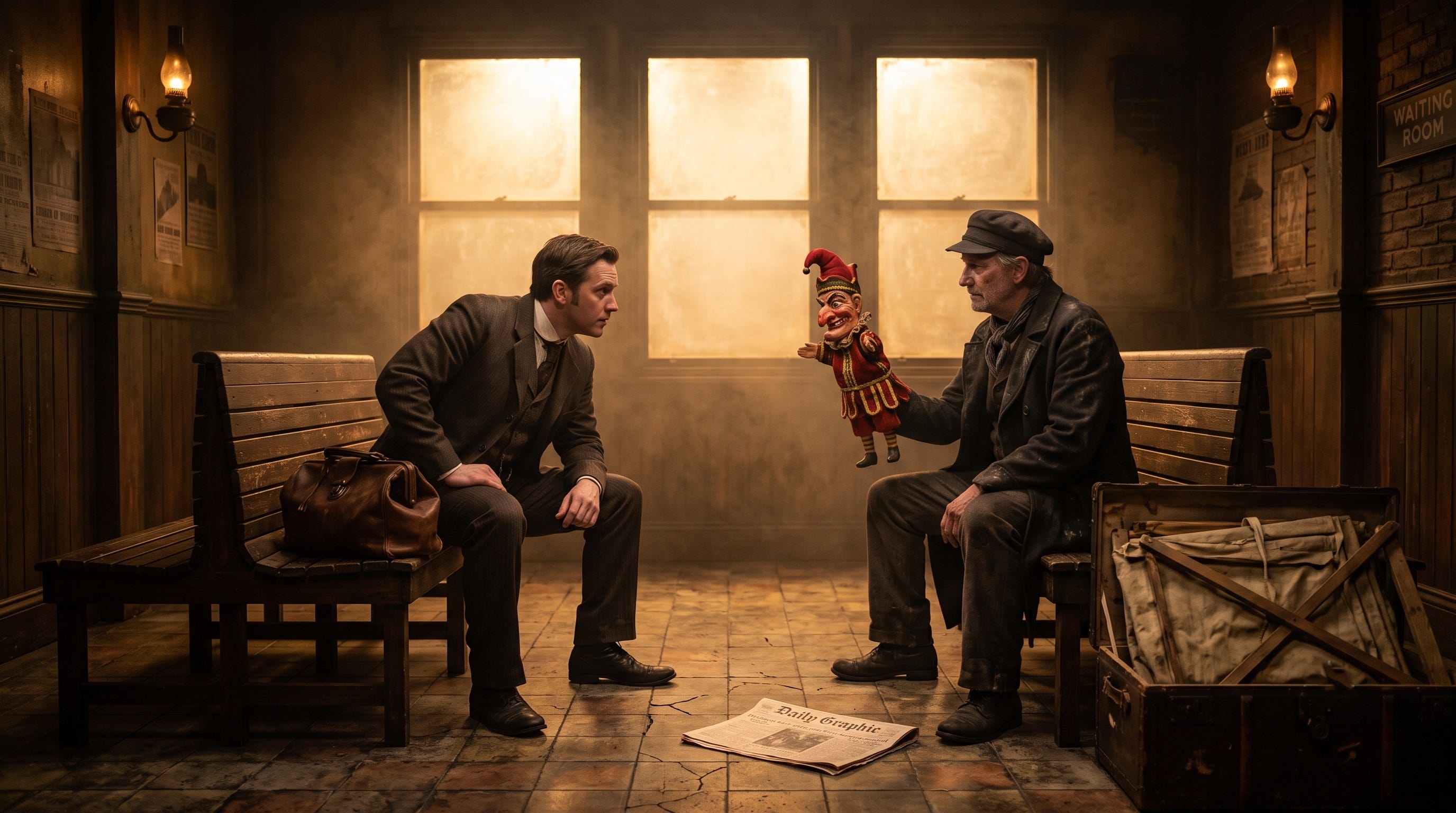
(The third-class waiting room of Liverpool Street Station. Quarter past eleven on the night of Tuesday, the thirty-first of July, eighteen eighty-eight. The room is nearly deserted. Two scarred wooden benches face one another across a floor of cracked encaustic tiles, their varnish long since worn away. Gas jets hiss and gutter in their iron brackets, throwing a jaundiced, restless light. Against the frosted windows, a warm summer fog presses heavily from the city streets, carrying with it the sweetness of stale tobacco and the heavier undertone of coal smoke and damp wool. Near the far bench, an evening edition of The Star lies face-down on the tiles, its pages already softening in the damp air. Beneath that bench, a battered steamer trunk occupies the floor; from it protrude the collapsed ribs of a canvas-wrapped Punch and Judy booth. Beside the trunk sits the PUPPETEER, a lean man of fifty or thereabouts, in a coat of indeterminate dark colour and a hat pushed well back from his brow. His hands rest on his knees, the fingers broad and calloused. There is about him the complete, almost animal repose of a man who has spent his life in foregrounds and fairgrounds and has long since made his peace with every variety of waiting. When he speaks, his voice carries the faint, permanent rasp of a man who has spent thirty years working a tin swazzle.
A shriek from a shunting engine, somewhere beyond the glass roof, holds for a moment and then fades. The gas jets tick.
The JOURNALIST enters through the waiting room door, a bulging leather satchel straining at his shoulder. He wears a respectable but faintly threadbare suit, the elbows worn to a dull shine. He pauses at the threshold, surveys the room with the unconscious, rapid habit of a man who catalogues every space he enters, then crosses and takes his seat on the bench opposite the PUPPETEER. He sets the satchel down heavily, opens it, peers inside, closes it again without removing anything. He straightens his cuffs. He glances at the clock on the wall, then removes his pocket watch, consults it, and replaces it. He glances at The Star on the floor. He glances at the PUPPETEER.)
JOURNALIST: The Colchester express, I take it. (He pauses. He becomes immediately aware that this observation was scarcely warranted.) That is to say, it is the only remaining departure listed. The board indicates nothing until the quarter past midnight at the very earliest.
PUPPETEER: (without opening his eyes) Wickford.
JOURNALIST: I beg your pardon?
PUPPETEER: That’s where the trouble is. A coal wagon off the up-line at Wickford. (He opens one eye, regards the JOURNALIST with mild, unhurried curiosity, and closes it again.) Spoke to a porter twenty minutes gone. Your board’s a good hour behind the facts, as per usual with this railway.
JOURNALIST: (with the beginning of a reach towards his inside pocket, caught midway, and abandoned) Yes. I had quite forgotten the singular genius of the Great Eastern for delay. I have been in London a fortnight and more.
PUPPETEER: (producing a pewter flask from somewhere inside his coat) One learns not to fight it. (He takes a pull, then extends the flask across the space between the benches without ceremony or expectation.) You look like a man who could do with it.
(The JOURNALIST hesitates briefly, then accepts. He takes a careful sip, nods, and returns the flask.)
JOURNALIST: That is most civil of you. Thank you. (Something in the set of his shoulders eases a fraction.) I have been covering the affairs of the match-factory girls, amongst other matters. One grows tolerably stale after a fortnight in lodgings off the Strand.
PUPPETEER: Read something of that in the papers. Did they do well for themselves, in the end?
JOURNALIST: Tolerably so. The owners conceded the principal grievances. Whether the agreements will hold in practice remains to be determined.
PUPPETEER: (a dry half-smile, eyes still closed) They usually say that.
(A silence. The fog presses at the windows. The JOURNALIST looks at the trunk beneath the bench opposite, at the canvas-wrapped ribs protruding from it, at the PUPPETEER’s calloused hands at rest on his knees. He looks with the fixed, cataloguing attention of a man who cannot prevent his mind from making notes, even when his notebook is closed.)
JOURNALIST: You are returning from the coast.
PUPPETEER: Prittlewell. Off Southend, properly speaking. (He shifts his hat a fraction.) The heat fetched the trippers out well enough at the start of the season. Last three weeks, they stopped coming. (A small shrug, without rancour.) Can’t fault them. The fog’s followed me all the way from Essex, I think.
JOURNALIST: (with a glance at the trunk) You are a Punch and Judy man, if I am not mistaken.
PUPPETEER: (with quiet, correcting firmness) Professor, if it’s all the same to you.
JOURNALIST: Professor. Forgive me. (A pause, then, with the air of a man gathering himself for something that may not land well:) I wonder if you would permit me to put a question to you. I confess I put questions for a living and the habit has annexed my private hours rather more thoroughly than is, perhaps, entirely dignified. I offer this as a confession rather than an apology.
PUPPETEER: (with the faint, easy smile of a man who has endured odder preambles) Ask away. The train won’t be here till midnight and I’m wide awake.
JOURNALIST: Thank you. (He settles forward, forearms on his knees, in the unconscious posture of a man conducting an interview from a hard chair, which is in fact precisely what he is doing.) It is this. I find myself frequently curious about the inner constitution of men whose occupations set them somewhat apart from the common run. And I have been wondering - which figure of the imagination, which creature of fiction or of the theatrical boards, do you consider most faithfully mirrors your own humours and disposition? Which phantom of the stage or the printed page, if you set him beside yourself in clear light, would most closely resemble the cut of your own character? Which imagined soul, in short, do you feel is wrought of the same clay?
(A silence. The PUPPETEER does not answer at once. He opens both eyes and looks up at the gas jet that ticks and wavers in its bracket, and a slow, private smile crosses his face: the expression of a man handed an unexpectedly interesting thing to consider.)
PUPPETEER: Now then. (He rubs the ball of his thumb across his calloused fingers, a habit so ingrained he does not notice he is doing it.) You’d expect me to say the red-capped rascal. The humpbacked wooden fellow with the stick.
JOURNALIST: I confess that was my presumption, yes.
PUPPETEER: And you ain’t entirely wrong. He’s a fine sort in his fashion. (He says this with a craftsman’s fond, detached regard, the way a carpenter might speak of a favourite tool.) Takes the stick to the quack physician, to the blue-coated officer of the law, to the snapping great reptile that goes for his sausages - and at the very last, he tricks the hooded executioner into the noose, the executioner’s own noose, mind you, and walks away whilst the other fellow swings. (A warm, private laugh.) Never loses a night’s sleep over any of it.
JOURNALIST: (quietly, with rather more earnestness than he intends) The triumph of appetite over conscience.
PUPPETEER: (considering this without offence, turning it over as one might turn a coin) Some would frame it so. I’d say the triumph of a man who don’t bow to what he can’t see the merit in. (A beat.) That’s a rather different thing.
JOURNALIST: (after a pause) You said: not entirely wrong.
PUPPETEER: Did, yes. (He looks upward again.) There’s another sort I’ve thought about more. Older in the tradition. You know the fool of the old plays? Not your circus tumbler - I mean the elder sort. The court jester, the licensed fool with the motley and the bladder on a stick. (He taps the side of his temple gently.) He’s the one the king keeps about him to say what nobody else in the court will dare say. Speaks it plain. And because the court finds him diverting, they hear it before they’ve thought to put their guard up.
JOURNALIST: (softly) The jester’s privilege.
PUPPETEER: His trade, I’d call it. (Something settles in him, a quiet certainty.) Put the truth in a sock with bells on and toss it across the room, and a man’ll catch it before he’s had time to keep his hands to himself. (He glances at his own hands.) That’s my constitution, I think. If I’m being square about it. The red-capped rascal’s the one I carry in the trunk. The motley fool is the one I carry here. (He touches his chest briefly, without drama.)
(A silence. Somewhere above the waiting room, high in the glass roof, the warm fog presses against the panes in a dull, luminous mass. A distant coupling iron settles and clanks.)
JOURNALIST: (with something that approaches genuine warmth) That is rather well put.
PUPPETEER: (dryly) You needn’t sound quite so surprised.
(A beat.)
PUPPETEER: Your turn.
JOURNALIST: I - I beg your pardon?
PUPPETEER: Fair exchange. You asked me. (He folds his arms with comfortable finality.) Which imagined soul is wrought of the same clay as yourself?
(The JOURNALIST is visibly, acutely discomfited. He shifts on the bench. He reaches for his satchel, opens it, and closes it again without removing anything.)
JOURNALIST: I am, as a general rule, the one who puts the questions.
PUPPETEER: I know. Tonight the rule’s off. (Not unkindly.) Come on. I ain’t going anywhere.
(A long pause. Somewhere in the sidings, a locomotive breathes out a slow, grinding groan, like a vast sleeping thing turning in its sleep.)
JOURNALIST: (slowly, as though working out the thought even as he gives it voice) There is a type in the novels of Mr Dickens - the type recurs in various forms throughout his work - a young man of modest means who has settled upon the conviction that diligence and the faithful accumulation of facts will, in time, constitute a sufficient claim upon the world’s notice. He copies documents. He arrives before the senior clerks and departs after the office boy has put out the lamp. He is not without feeling - I would not suggest that. But he has learned, over time, to mistrust it, because feeling has never in his experience produced a single line of useable copy. He watches the principals of the story moving about him, performing their great and terrible actions, and he records their statements with scrupulous accuracy.
(A beat. The PUPPETEER watches him without interruption, with steady, quiet attention.)
PUPPETEER: That doesn’t sound much like a hero.
JOURNALIST: No. (He looks at the floor.) He is the man who writes about heroes. Who takes their measure, records their declarations, and reduces the whole affair to three column inches in the morning edition and a halfpenny for the boy on the corner.
(A silence. The gas jets hiss on.)
PUPPETEER: And does he mind that?
JOURNALIST: (the smallest, least expected smile) I am not certain he has ever put the question to himself plainly.
(The PUPPETEER regards him for a long, quiet moment. Then he leans forward, opens the clasp of the steamer trunk with one practised hand, roots about briefly inside, and brings out a small wooden figure - the red-capped rascal, the humpbacked fellow - ten inches of painted beechwood and bright worn fabric, considerably battered from the season’s work. He holds it upright in his broad, calloused hand.)
PUPPETEER: You know what he’s made of, this one?
JOURNALIST: (leaning forward slightly, despite himself) Beechwood, one would imagine, or perhaps -
PUPPETEER: He’s made of people looking at him. (He turns the figure in his hand with the ease of long familiarity.) Without the eyes on him, he ain’t anything but a painted stick with a nose on it. (A pause.) Your three column inches - that’s eyes on a thing. That’s what makes it real in the world, that it’s been set down and seen by someone who knows how to look. (He settles the figure on his knee.) In the show, there’s always a bottle-man. That’s the fellow who goes round with the hat after it’s done, collects the ha’pennies from the crowd. Without him, the show don’t pay, and if the show don’t pay, the show don’t go on. (He looks up at the JOURNALIST, calm and direct.) Every Professor needs his bottle-man.
(A beat.)
JOURNALIST: (very quietly) And you are suggesting that I -
PUPPETEER: I’m suggesting it’s honest work. And necessary. (He replaces the figure in the trunk with practised care and fastens the clasp.) That’s the whole of my suggestion.
(A silence, longer than the others. The JOURNALIST looks at The Star lying on the floor, its pages soft and spreading in the damp air. He looks up at the guttering gas jet. He says nothing for a time.)
(Then, from somewhere beyond the far platform, a whistle blows: two short, sharp blasts, close together. After a brief interval comes the deep, slow groan of a locomotive beginning to move, the long sibilation of steam released upward through the glass roof, the solid clank of coupling irons taking the strain.)
PUPPETEER: (already rising, unhurried, reaching for his trunk) Midnight, give or take. Told you. Wickford.
JOURNALIST: (standing, hoisting his satchel) So it is. (He stoops, almost without thinking, and picks up The Star from the tiles, folds it, and tucks it under his arm.)
(The PUPPETEER hoists the trunk with the ease of a man who has lifted it a thousand times in a thousand places, settles the collapsed booth under one arm, and moves to the door. At the door, he holds it open and pauses.)
PUPPETEER: I take it you’d have it in the paper.
JOURNALIST: I had not - that is, I would not do so without your -
PUPPETEER: No names. I don’t hold with my name in the papers. (Quite calmly.) Bad for the mystery.
JOURNALIST: As it happens, I don’t know your name.
PUPPETEER: (a genuine, unhurried smile, directed not precisely at the JOURNALIST but at the general proposition of the thing) No. And there you are. (He nods towards the platform.) After you, then. The column inches won’t collect themselves.
(The JOURNALIST passes through the door into the fog and the hiss of steam. The PUPPETEER follows. The door swings quietly to behind them.
The waiting room is quite empty. The gas jets hiss and tick. The clock on the wall measures the interval in which nothing happens.
On the encaustic tiles, where the JOURNALIST was sitting, a single pencil stub lies where it fell from his satchel, unnoticed, catching the jaundiced light of the gas.
End of scene.)
Bob Lynn | © 2026 Vox Meditantis. All rights reserved.