
The Broth Before the Sun
Which is the best restaurant in your city?

Saturday 15th August 1366
Hangzhou, China
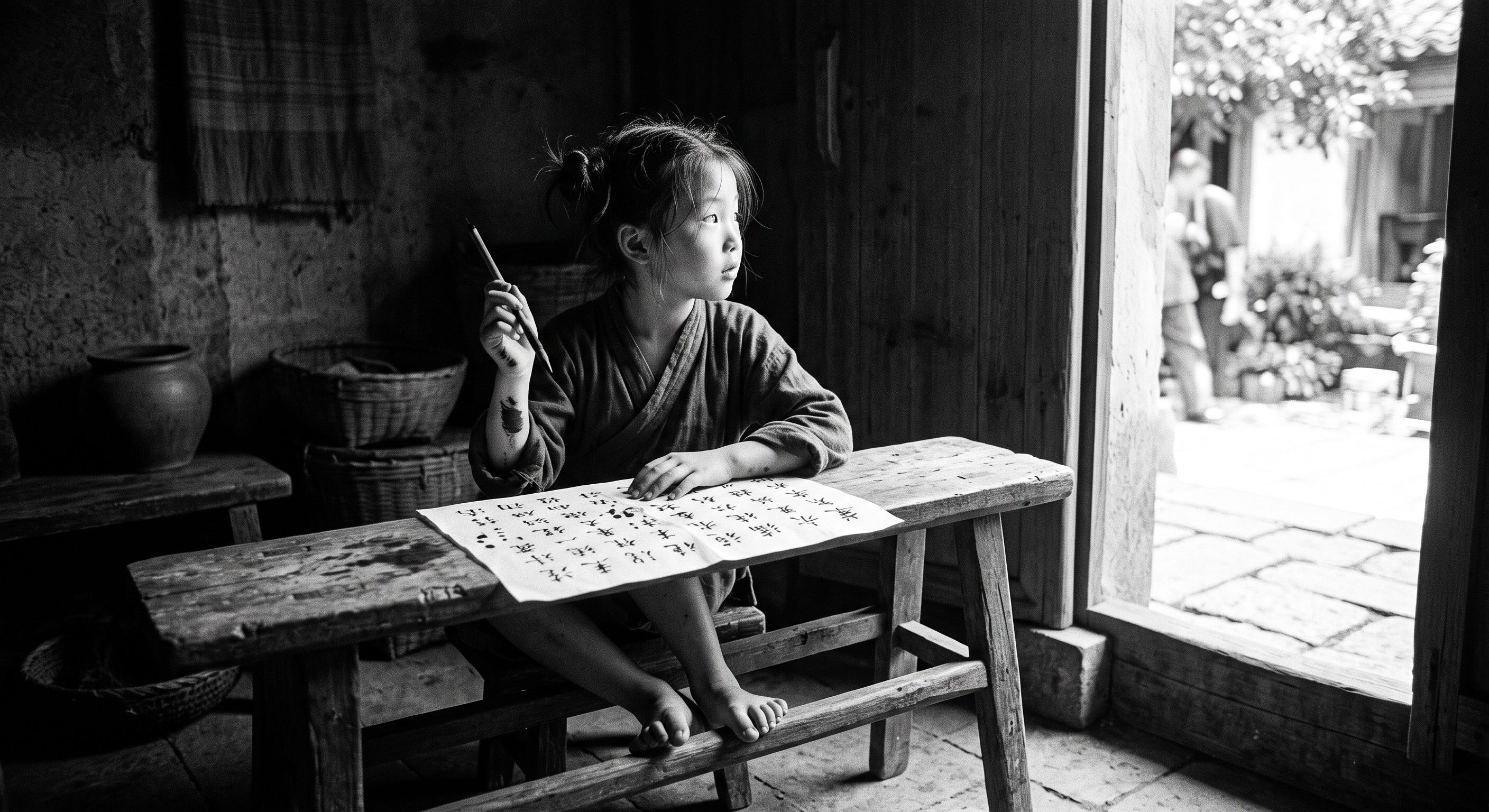
The character for mǐ has eight strokes. Grandmother told me. She told me this morning and then she said it again when I was not making the right face for listening, but I was listening, I was, I cannot always make my face do what it should when it is this hot and the cicadas are this loud.
Do you hear them? The cicadas. They are in the courtyard tree, or maybe in the tree on the other side of the wall, I cannot tell which. They have been screaming since before I sat down and they have not stopped once. Not for a breath. I think they do not breathe. I would be very tired from all that screaming, my throat would hurt, but they have no such trouble.
I have written mǐ many times this morning. Look. Here and here and here, all the way to the edge of the paper. Eight strokes each. I know the shape of it now the way I know the shape of the house when it is dark, without looking, just from where things are. And still she said: again. So I wrote it again. And the ink went on my sleeve. I do not know how. I was careful with the brush, very careful, and still it went there, and now there is a mark like a fish, or like a bird, I have not decided.
Grandmother is in the back of the house. She heard something move, a pot or a basket, and she went to look. So I have put down the brush. Just for now. Just a small rest.
The bench is too short for me. My feet do not reach the floor properly, so I keep them hooked on the front bar of the bench, and after a while that makes them feel strange, like something pressing from inside, like small stones under the skin. Grandmother says sit properly. But if I sit properly my feet hang, and hanging is worse than pressing. I have not explained this to her. I have just kept my feet on the bar and she has kept saying: sit properly.
The light is on the west wall. When it reaches the top of the west wall it is nearly midday. She told me which wall and which position so I would know without asking.
Nearly midday.
You are here. I see that you are looking at the paper. Yes, I know, there are more to write. I know that.
I will tell you something first.
I am thinking about food. I have been writing mǐ since morning, and mǐ is rice, and rice is food, and I have not eaten since the small meal before the lesson. And just now I heard it from the lane, two voices going past the window, one asking the other: where is the best place to eat in this city? What is the best eating-house?
I will answer that. I have a very clear answer.
It is not the place on Zhong’an Bridge. I know that is what you are thinking. Everyone thinks of that one. The vinegar-fish. The old man who stands outside and calls to the people going past. Very famous, very old, the grown-ups speak of it with a certain voice, the voice they use for things that have been good for a long time. Grandmother herself says it is very fine.
I have eaten there twice.
I do not care for fish.
Not like that, not with the vinegar. The bones are small and you must work to get the meat free, and the vinegar stays in your mouth after you have already finished. I think of it as the food still arguing with you. I do not want food that argues. I want food that makes my mouth happy and then rests.
Three lanes from our house, not the big avenue but the lane behind it, the one that bends left past where the old man mends baskets, there is a cook-shop with a red cloth over the door.
Not a sign. Just the cloth. I cannot read signs yet, not properly, only the characters Grandmother has taught me, and mǐ now, always mǐ from this morning. But I would know that cloth from much further away than three lanes. It is a deep red, the red of something old that is still good, not bright, not shining, just sitting there being that colour, sure of itself, and in hot weather it moves a little in the doorway even when there is no wind, because of the steam rising from inside.
The woman who runs it has her hair pulled back tight and two pale marks on her forearm from the steam baskets. I have looked at them. I do not ask. Grandmother has a mark on her hand from before I was born and I know not to ask about marks.
The woman makes soup-dumplings.
You know what those are. Small, white, pleated at the top, many tight folds pressed together, and inside the meat there is somehow soup, which I have thought about many times and do not understand. How does the soup get inside? Grandmother explained it to me. I listened. I still do not understand. But it does not matter, because the soup is in there, it is, and when you take one up you must be careful.
This is important. Listen to this part.
If you bite wrong, if you are in too much of a hurry, the soup bursts out all at once and burns your tongue and your chin and sometimes your hand. Once it went on my neck. There was a mark for two days. Grandmother laughed. She said I was too eager. I was not too eager. I was hungry. There is a difference, and she knows it as well as I do.
If you bite right, you tip the dumpling just a little, just a little, and let the very edge of the soup come to meet your tongue first. A small taste before the rest follows. And it is, I do not know exactly the right word for it, it is very hot and very rich and it tastes like something kept warm on purpose for a long time, like warmth that had somewhere to go and arrived there. Grandmother says the woman begins her broth before the sun rises. I believe that. I have tasted it and I believe it. It tastes like early morning. It tastes like the time before things start.
She gives me an extra one.
Not everyone. Not just anyone who comes in. She is a careful woman, you can see it, she measures things, she watches the portions, she does not throw food at people for no reason. But if I bow properly, a real bow, not the little nod of the head that means nothing, a proper one with both hands together and the back going all the way down, she looks at me. Just for a moment. Just a breath’s worth of looking. And then she puts one more dumpling in my bowl.
One extra. Always the last.
And it is always the best one. I do not know if she saves it for me. I think she does. I think she is the kind of woman who knows which one is the best and she keeps it back and watches to see if I will bow properly, and I always do, I always make sure, because I know what is in her hand.
Grandmother watches me do this. She stands a little to the side and she makes the face that is not a frown and not a smile, the face that means: I see this and I am deciding whether to have feelings about it yet. I know all of Grandmother’s faces. Eight years and I know every one.
People do not speak much about that cook-shop. It is off the big avenue, back in the lane, and you have to know to find it. The people who come are the same ones each time. The basket-mender. A few women I do not know from further away. Grandmother said once there is a family from the far side of the city who walks a long way every week just for those dumplings, walks all that way and comes back again. I believe it. I have walked to the West Lake, the full walk down to where the willows touch the water, and I would walk further than that for those dumplings if I had to.
But I do not have to. Three lanes. That is all.
And here is the thing, the thing that makes it the best and not only a good one among many. It is not only the dumplings. The dumplings are the best dumplings I have eaten. I have eaten dumplings at the stall near the big temple gate and the one by the water with the yellow curtain, and the ones by the temple gate were fine, they were, but not like this, not like the red-cloth place. But it is not only the dumplings.
It is that Grandmother takes me there when I finish my characters.
That is the rule she made. All the characters done, done properly, all of them, not scrawled fast and smeared, and then she puts on her shoes and says: come, then. And I am already at the door. I am always at the door before she has finished saying it.
We walk slowly because her knee is bad, and the lane in the afternoon is in shade and not as hot, and she walks beside me and sometimes she talks and sometimes she does not and I do not mind either way, and we go in and the woman sees us and nods, she knows us now, she knows what we take before we have said it, and Grandmother says a few words while I bow, both hands, all the way down. Then we sit. The tea comes first, a little bitter, the same tea each time, and then the dumplings come, and everything is finished. The bench is not under me. My feet are on the floor. There is steam and warmth and the smell of the broth that started before the sun rose, and Grandmother’s hands are around her cup, and she looks at me over the rim, and I look back at her.
That is the best place. Red cloth, three lanes down. Not the Zhong’an Bridge fish, not the famous old one, not the one everyone has decided to have opinions about. The woman with the burn marks. The extra dumpling. The bow.
So. I have told you.
And now I have been sitting here talking all this time and my brush has gone dry on the paper and Grandmother is going to come back and see that I stopped. She will know I stopped. She always knows. She has a bad knee and she is old and she knows everything that happens in this house, I do not know how, I have stopped trying to understand it.
The light has moved on the west wall since I last looked at it.
Four more characters. Maybe six. I will write them now. They will not be as careful as the morning ones but they will be done, all the strokes, eight each, and they will be done, and that is what matters, done is done.
I hear her coming back through the house.
I am picking up the brush. The ink is thin from drying but there is enough left for the strokes. I will do four, or six, and I will do them now, and then I will go and get my shoes. They are by the door already. I put them there this morning before the lesson began because I knew I would want them ready. Grandmother’s shoes are beside them. She put them there herself. She always puts them there on the days we go.
Mǐ. Mǐ. Mǐ. And another. And another.
There. Grandmother. Look. Count them. Are they done?
She is nodding.
She is reaching for her shoes.
Bob Lynn | © 2026 Vox Meditantis. All rights reserved.