

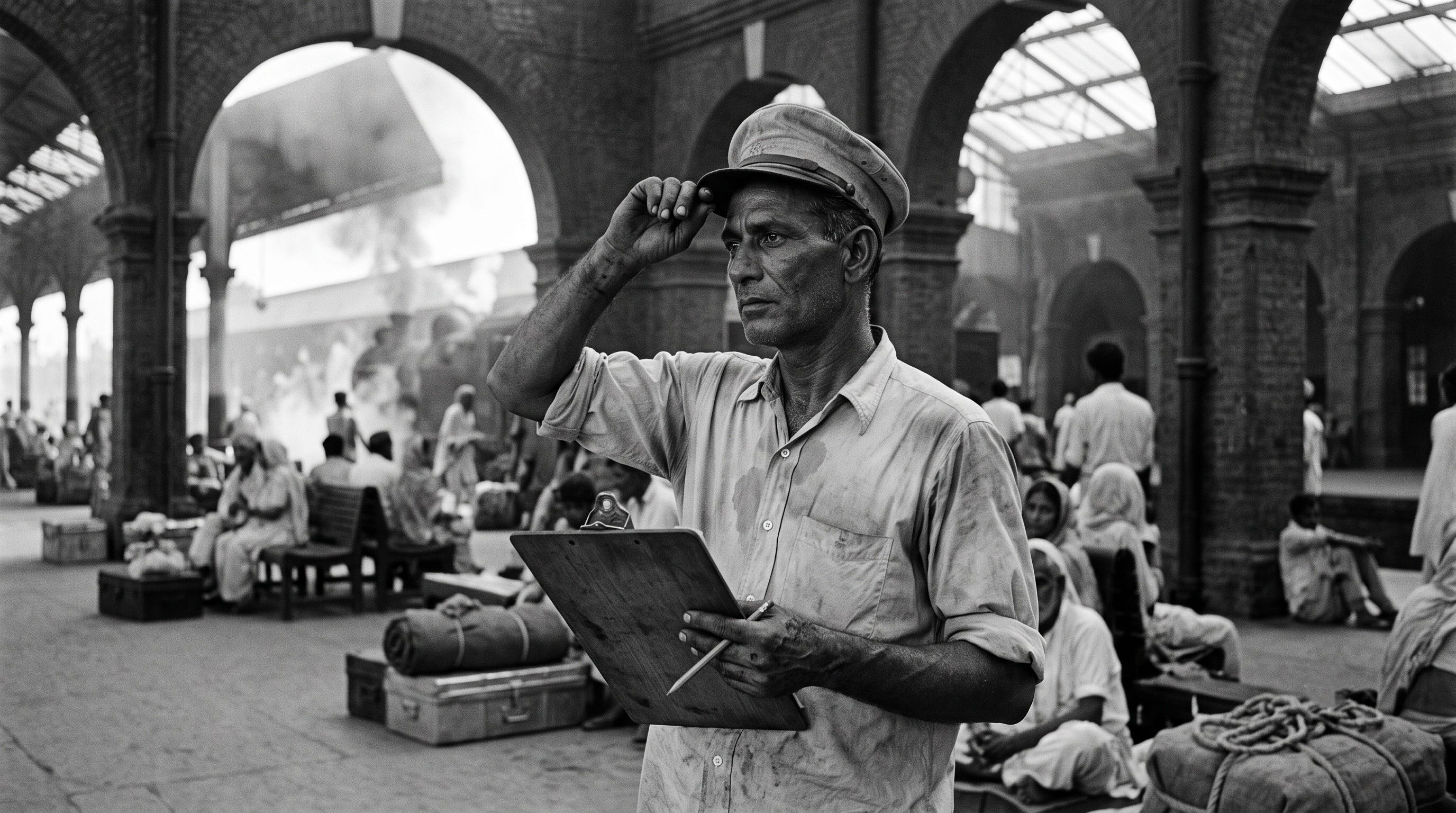
Arthur Crawford, Senior Dispatcher, Lahore Junction, North Western Railway.
Monday, 28th July 1947.
Ah, you’re still there. Stand where you like, I’m not sending you away. Only mind yourself when the 9:40 comes through. She’s running eight minutes late already and they won’t be gentle bringing her into platform two. Eight minutes. In ordinary times I’d have someone up for that. Today I wrote it in the ledger and held my tongue. You pick your battles, in this life.
Right. You were asking about...
(He lifts a hand, counts something on the far platform. A chain of wagons is being shunted on the western tracks. He watches until they stop.)
Theek hai. Good. Where were we.
Thirty-one years I’ve stood at this station. My father before me, and his father drove engines on this very line when the gauges were still a muddle, before they sorted it all out. Three generations of Crawfords on the North Western Railway. I dare say there will not be a fourth. Not here, at any rate.
Do you see that family there, the woman with the two children and the tin trunk, the bundle tied up in rope? They’ve been on that bench since yesterday morning. I’ve watched them. The stationmaster’s babu keeps moving them along and they keep coming back. God only knows where they’re going. Half the people on these platforms today don’t have a ticket. They have a direction. Whichever side of whatever line they think might hold. And the line doesn’t exist yet. It is being drawn right now, by some fellow in a room in Delhi. Or perhaps Lahore. A barrister, they say. A Sir Something. One is fairly confident he has never stood on a Punjab platform in July. Never seen what this heat does to steel, or to people. He is drawing the line that will cut through the middle of this city, and when he’s done he’ll catch the next boat home to get on with whatever it is barristers do in the autumn.
The writing has been on the wall for some months. We’ve all been reading it. Nobody wanted to say the word aloud.
(He wipes his brow with the back of his wrist. The air is thick, sweltering.)
This humidity is something extraordinary, even by Lahore standards. You feel it? Like breathing through a wet flannel. By two o’clock it’ll rain for twenty minutes and then the sun comes back twice as fierce. I have known this weather for fifty years. I know the smell of it just before the downpour, the earth opening up as though the ground itself is relieved. I call it home. I expect I’ll call it that wherever I end up.
Hmm.
You asked me something. Forgive me, I was attending to things. A song lyric. Yes.
I’ll tell you what I’m not. I’m not a poetry man. I am a railwayman. I read gradient tables and load schedules. I am perfectly at home with a signals manual but I have never once been the sort of fellow who keeps verses in his breast pocket. My late wife would confirm that, and she’d add one or two things besides.
And I’ll tell you who I’m not going to quote at you. Kipling. I know everyone expects the Anglo-Indian to reach for Kipling, but my father had views about Kipling which I’ll spare you in the interests of time. He understood the railway, I’ll grant him that. Anyone who paid attention understood the railway. He got a great deal else backwards, in my father’s considered opinion and my own. And the hymns, yes, I know them, I attended All Saints the same as everyone else. All Things Bright and Beautiful. Eternal Father Strong to Save. Strong to save. I’ll leave that one there. And the marching songs, the war gave us enough of those. In the shunting yards at Karachi, in the mess at Rawalpindi, on the long overnight runs when the wireless was working and sometimes when it wasn’t. I can’t hear most of them now without hearing, underneath the melody, the voices of men who didn’t come back to finish the verse. So those don’t count.
But. There is one.
(He sets down his pencil. A coupling clatters somewhere to the south. He does not look.)
I’ll Be Seeing You. You know it? Bing Crosby made it his own during the war. It was everywhere, in the canteens and the billets and on the wireless at odd hours of the night. The memsahib who ran the refreshment counter at Rawalpindi, the winter of ‘44, she used to hum it while she poured the tea. Sentimental, I always thought. A love song for separation. Boys sending it home to their girls in Bradford and Baltimore, girls sending it back across the water. I found it rather treacly, if I’m being honest. Rather too much longing made ornamental.
But there’s a line in it. Four lines, really.
I’ll find you in the morning sun. And when the night is new. I’ll be looking at the moon. But I’ll be seeing you.
(A pause. On platform one, a child cries briefly and is hushed.)
I used to take that as a song about a person. A sweetheart. The obvious reading. But then, I was on a long run once, Lahore to Multan and back, a night shift at the end of ‘44, too many hours and too little to occupy the mind except the signals and the dark. And that line came back to me. And I thought: no. That’s not about a woman. Or rather, it is about a woman, theek hai, but it is about something more than that. It is about a place.
Because here is the thing. You can leave a place. That is simple enough. You put one foot in front of the other, you board a train, you do not look back. The place does not follow you. It stays where it is. It carries on without you. The jacarandas on the Mall come out in the spring as they always have. The Badshahi Mosque sounds the same at dusk as it did yesterday and will the day after. The 4:15 to Peshawar leaves platform six with the same ghastly shriek it has been making since before I was born. The place does not grieve your absence. Places don’t grieve.
But you carry them. That is what nobody tells you. You carry every street and every smell and every angle of the light at a certain hour of a certain season. You carry it not as memory, mind you. Memory fades. Memory is merciful that way. No. You carry it as something alive. Something that insists on being present even when it is not and cannot be. I’ll be looking at the moon. But I’ll be seeing you.
I have imagined... I have had rather a good deal of time to imagine, these past weeks. I have imagined myself in, say, five years’ time. An old man in a damp terrace in Wolverhampton, curtains that don’t quite fit the windows. Or in a hostel in Melbourne, not knowing the street names, not knowing the birds. I imagine waking in the morning, looking at whatever grey or foreign light comes through the window, and I imagine this. This arch. That platform. The chaiwallah with his brass pot, going his rounds. A train coming in from the west, still carrying the dust of the Bolan Pass on its flanks.
The red brick of the stationmaster’s office with the stain from last monsoon that never quite came off. The coal smoke and the marigolds and the smell of the open drains that you stop noticing after a while and then realise, one day, far too late, that you would miss with everything in you. The coolie who has been sleeping on the same bench on platform three since at least 1936. I have never once asked his name, God forgive me, and now I suppose I never shall. All of it. All of that. Not as something past but as something insisting on being present. That is what the lyric knows.
That is what Kahal wrote without fully knowing how right he was getting it. Not the sweetheart at all. The place. The places we leave become ghosts we carry.
(He picks up the clipboard again. His voice does not waver.)
My community is in a queer position, as I expect you know. We are not quite Indian enough for the new India, not quite English enough for England. We were told, all our lives, that the railway was our home. Our calling. The thing we were fitted for by birth and by training and by three generations of belonging to it. And it was true. We were made for it. I believed it absolutely. I still believe it, for what that’s worth now. But the railway will go on in a new arrangement, and we shall be neither one thing nor another, as we have always been neither one thing nor another, except that it mattered less before.
The Empire is folding up its tables and chairs and sailing home from Bombay. And it does not occur to those in the rooms where decisions are made, not genuinely, not in any way that changes anything, that some of us have nowhere to sail back to. England is not a place I have ever been. My grandfather was born in Rawalpindi. My father was born in Lahore. I was born in Lahore. I have a cousin who went to Bristol during the war and wrote to say the cold got into his bones and he could not shift it. That is England, then. The cold that will not shift. Against which, I have this.
(A pause. He looks out at the platform.)
One supposes the Lord has His reasons. Though the reasoning has been somewhat difficult to follow of late.
(Two sharp whistle blasts from the eastern approach. He straightens.)
That’s the goods train from Amritsar, coming in on the eastern line. Forty minutes late, which means there’s been trouble somewhere along the route. Crowd on the line, or something worse that I’ll hear about shortly and be required to log without comment. I am about to have three conversations simultaneously and write all of it down as I go, so you’ll forgive me if we close here.
(He moves toward the edge of the platform. Then, without turning:)
I’ll be looking at the moon.
That’s the whole of it, really. That’s all you need.
Mind yourself on platform two.
Bob Lynn | © 2026 Vox Meditantis. All rights reserved.